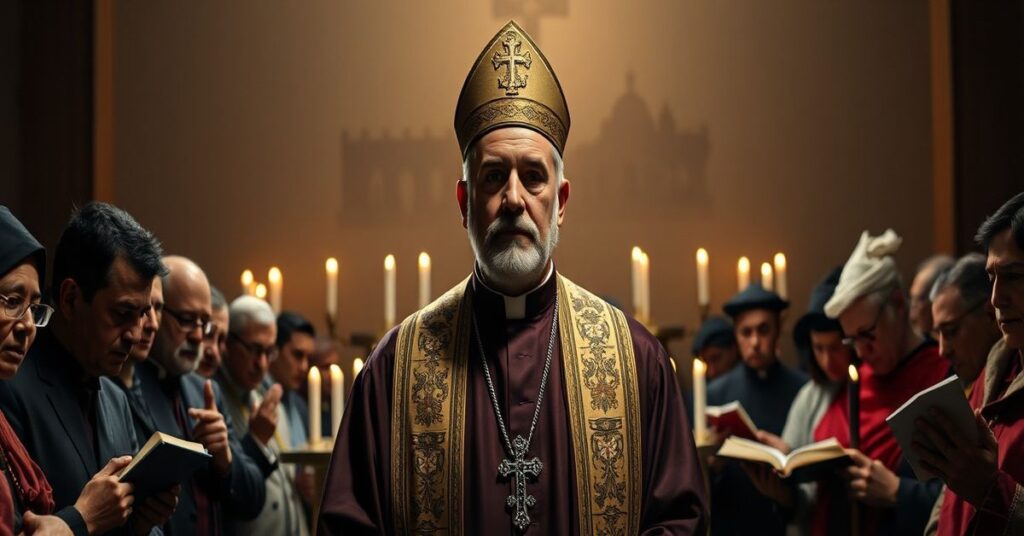
The Pillar reports on financial misconduct allegations against Bishop Emanuel Shaleta of the Chaldean Eparchy of St. Peter the Apostle. The bishop denies wrongdoing, claiming to be the victim of a „vicious media campaign,” while a Vatican-ordered investigation reportedly concluded months ago with findings of significant fund misappropriation. Cardinal Louis Sako confirms considering a transfer but denies canvassing support, stating he awaits the Holy See’s final decision.
Naturalistic Reduction of Ecclesial Authority to Financial Auditing
The entire framework of the reported scandal and its handling is reduced to a matter of financial administration and procedural transparency, a hallmark of the post-conciliar ecclesiology that has emptied the supernatural from the Church. The bishop’s defense hinges on „integrity and transparency” in „Church financial matters,” while the Vatican’s response is framed by „thorough investigations” to „reveal the truth and to take a just and impartial decision.” This language is not that of canon law or theological censure, but of corporate governance and human resources. The sine qua non of Catholic governance—the salvation of souls, the preservation of doctrinal purity, and the supernatural sanction of ecclesiastical office—is entirely absent. The crisis is presented as a managerial failure, not a potential loss of sacramental character and jurisdiction through public scandal and suspected mortal sin. The report notes the bishop „did not have substantiating paperwork confirming distributions,” reducing the distribution of alms, a corporal work of mercy, to a bookkeeping deficiency. This is the logical endpoint of a „Church” that has become a humanitarian NGO, where the primary evil is the mismanagement of a budget, not the potential desecration of the sacred goods of the altar and the scandal given to the faithful.
Linguistic Symptomatology: The Language of the World, Not the Church
The vocabulary deployed in the article is exclusively that of secular media and corporate scandal. Phrases like „media campaign,” „agendas,” „control the Church of Christ,” „fabricating… lies,” „positive testimonies,” „evidence, documentation, and time,” „thorough investigations,” „just and impartial decision,” „misinformation campaigns,” „exploited by certain militias and political groups,” and „very busy” are the lexicon of public relations and political spin. There is no mention of suspicio de haeresi, canonical trial for crimen, the duty of the Patriarch to protect the faithful from a potentially scandalous and unworthy pastor, or the supernatural consequences of public, notorious sin for the exercise of jurisdiction. Even the bishop’s appeal to his 42 years of service as „priest and as a bishop” is a human-resources metric, not a theological argument based on orthodoxy and sanctity. This linguistic shift is not accidental; it is the necessary expression of a mindset that has replaced the supernatural ends of the Church with temporal, bureaucratic ones. The „Church” described here is a corporation whose main asset is its public image and whose primary problem is a PR crisis.
Total Omission of Supernatural Criteria and Canonical Penalties
The most damning evidence of the apostasy of the „Chaldean Catholic Church” structure is the complete silence on the supernatural and canonical dimensions of the case. According to the immutable law of the Church, a public, notorious, and gravely sinful act—especially one involving the potential theft of sacred goods and scandalous personal conduct—renders a cleric ipso facto unfit for office and likely incurs automatic excommunication (latae sententiae). The 1917 Code of Canon Law (Can. 188.4) states that an office becomes vacant „by the very fact and without any declaration” if a cleric „publicly defects from the Catholic faith.” While this is primarily about heresy/apostasy, the principle of automatic loss of office for public, grave delicts is clear. More directly, Can. 2350 §2 prescribed deposition from office and infamy for clerics guilty of „theft, rapine, or any other similar crime.” The article mentions no canonical trial, no crimen for furtum sacrilegum (sacred theft), no mention of the bishop being ordered to refrain from exercising his ministry, no discussion of the obligation of the Patriarch and the Holy See to provide an apostolic administrator to govern the diocese in the bishop’s absence. Instead, we have „suggesting the possibility of transferring” and waiting for „clarity.” This is a mockery of canonical discipline. It treats the episcopacy as a political appointment to be managed, not a sacred office to be protected from unworthy holders. The silence on the potential necessity of a canonical trial for delictum gravius and the automatic penalties it would incur is a definitive proof that the structures in question operate on a purely natural, human level, devoid of true ecclesial authority.
Symptomatic Manifestation of the Neo-Church’s Post-Vatican II Apostasy
This scandal is not an anomaly but the logical fruit of the conciliar revolution. The „Chaldean Catholic Church” is a constituent part of the „Catholic Church” of the Vatican II sect. Its governance reflects the principles of *collegiality* and *synodality*—opaque, slow, administrative, and focused on perception management. Cardinal Sako’s statement that he suggested a transfer „because the situation was not clear at the time” and his hope that Shaleta „might be allowed to take up a position in the patriarchate’s administration” reveals a mindset where personal connections and political maneuvering within the hierarchy outweigh objective justice and doctrinal purity. The delay in appointing an apostolic administrator, despite a concluded Vatican investigation, is a dereliction of the duty to govern the local Church in the name of Christ. It prioritizes the „reputation” of an individual bishop and the „stability” of the diocese over the spiritual good of the faithful, who are scandalized by a pastor accused of frequenting a brothel and mishandling hundreds of thousands. This is the „church of human devices” condemned by St. Pius X in Pascendi Dominici gregis. The entire affair is conducted in the language of the world, with the „Holy See” acting as a final appeals board for a corporate dispute, not as the Supreme Tribunal of the Church judging a matter of faith and morals involving a sacred minister. The bishop’s own defense, invoking the „Holy Lenten season” to pray for his „enemies,” while simultaneously accusing them of fabricating lies, is a caricature of piety used as a rhetorical shield against accountability—a perfect synthesis of the modernist „immanentization” of grace and the naturalist’s use of religious language for self-justification. The faithful are reduced to a „media” to be managed and a „community” whose „positive testimonies” can be mustered, not a Mystical Body whose sacramental life is jeopardized by an unworthy pastor.
Conclusion: The True Church vs. The Neo-Structure
The case of Bishop Shaleta is a microcosm. It reveals a „Church” where:
1. The primary concern is financial propriety and public image, not sacramental integrity and doctrinal purity.
2. The language is entirely secular, borrowed from corporate and political spheres.
3. Canonical penalties and supernatural criteria are systematically ignored in favor of administrative „transfers” and vague „clarifications.”
4. The authority of the Patriarch and the „Holy See” is exercised as a managerial, not a pastoral and judicial, power.
This is not the Catholic Church of all time. It is the post-conciliar sect, the „neo-church,” where the apostasy from the integral faith has progressed to the point where even gravely scandalous conduct by a bishop is treated as a human resources issue. The faithful are left with a choice: remain in this man-made, naturalistic structure, or adhere to the one, holy, catholic, and apostolic Church as it existed before the revolution of Vatican II, which subsists in the sedevacantist continuity of the true episcopacy and papacy. The Pillar’s reporting, while factually detailed, is itself a product of this new ecclesial reality, analyzing a cancer with the tools of the very system that generated it. The only „integrity and transparency” that matters is that of the unchanging Faith, which these structures have abandoned.
Za artykułem:
Chaldeans confirm investigation into missing money, bishop denies wrongdoing (pillarcatholic.com)
Data artykułu: 24.02.2026